Essential Math for Games Programmers
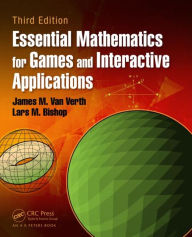
A one-day course and a set of PowerPoint slides are not enough to hope to cover all the material in any great depth. So Jim Van Verth and Lars Bishop wrote a book, with the help of our friends at AK Peters and CRC Press:
Essential Mathematics for Games and Interactive Applications, Third Edition, by James M. Van Verth and Lars M. Bishop, AK Peters/CRC Press, September 2015, 618 pages, ISBN 1482250926.
Even though I've worked with these systems for years, I found new ways of looking at several topics that make them easier to remember and use. For someone new to 3D programming, it is extremely useful-it gives them a solid background in pretty much every area they need to understand.
-Peter Lipson, Toys for Bob, Inc.
Based on and expanding on our tutorials, Essential Mathematics for
Games and Interactive Applications presents the core mathematics
necessary for sophisticated 3D graphics and interactive physical simulations.
The book begins with numeric representation, linear algebra and matrix manipulation and expands
on this foundation to cover such topics as texture filtering, interpolation,
animation, randomness, and basic game physics. Essential Mathematics focuses
on the issues of 3D game development important to programmers and includes
optimization guidance throughout.
And now Essential Mathematics for Games and Interactive Applications is out with a new third edition, featuring completely revised chapters on lighting and graphics and general rewrites to all the material to bring it up to date and make it easier to follow.
U.S. readers can purchase the book online from Amazon or Barnes and Noble. It can also be purchased from Amazon Canada, Amazon.co.uk and Amazon.co.jp.
Table of Contents:
- Real-World Computer Number Representation
- Vectors and Points
- Matrices and Linear Transformations
- Affine Transformations
- Orientation Representation
- Viewing and Projection
- Interpolation
- Geometry and Programmable Shading
- Lighting
- Rasterization
- Random Numbers
- Intersection Testing
- Rigid Body Dynamics
Errata
A PDF containing errata is now available for download.
Updates
No updates for the third edition yet.
Second Edition
For those still using the second edition, here are the errata and updates.
Errata
A PDF containing errata is available for download (thanks to Sundaram Ramaswamy for compiling it). Some errata that require more discussion have been posted to the blog with commentary.
Updates
For the latest source code, please go to our GitHub repository. It is for the third edition, but for the most part should match up well with the topics covered.
First Edition
For those still using the first edition, here are the errata and updates.
Errata
A PDF containing most errata is available for download. Some errata that require more discussion have been posted to the blog with commentary.
One additional erratum on Page 33: When performing Gram-Schmidt orthogonalization we should be dividing by the square of the length of wi.Updates
For the latest source code, please go to our GitHub repository. It is for the third edition, but for the most part should match up well with the topics covered.
Copyright © 2008-2015, James
M. Van Verth
Last updated:
May 22, 2016